
Built by a former UC Berkeley admissions reader
Even if your kid hasn't written a single word yet. All 27 real admitted-student essays, every one coached by Coach Tony Le, tagged with the student's school, type, and topic — instant access inside your vault the moment you check out.
These aren't templates or anonymous Reddit essays. They're 27 real admitted essays I personally coached, each tagged with the school, the essay type, and the topic, so you can see exactly what a winning essay looks like.
"I read three essays from the vault and realized my daughter's draft was on a completely wrong track. We rewrote it in a weekend."
"I'm South Asian, my kid is STEM, and finally I could find essays from families that looked like ours. That changed everything."
"We were about to sign a $24,000 contract with a private consultant. Found this for $27 first. Wish I'd found it a year earlier."
I'm going to show you the exact essays that got students into UC Berkeley, UCLA, Stanford, MIT, Cornell, Yale, Princeton, Caltech, USC, CMU, and more. Every one of them written by a real student we coached. Every one tagged with the school it got into, the essay type, and the topic — so you know exactly what context to read it in.
So you'll never have to wonder:
You'll just know. Without sitting through another 90-minute YouTube video on "how to write a college essay" that gives you advice but no actual essays to compare it against.
Instead, it has everything to do with one thing most families have never been shown:
What a winning essay actually looks like.
Not what an expert says a winning essay looks like. Not a checklist of what "should" be in there. The actual essays. From actual students. Who actually got in.
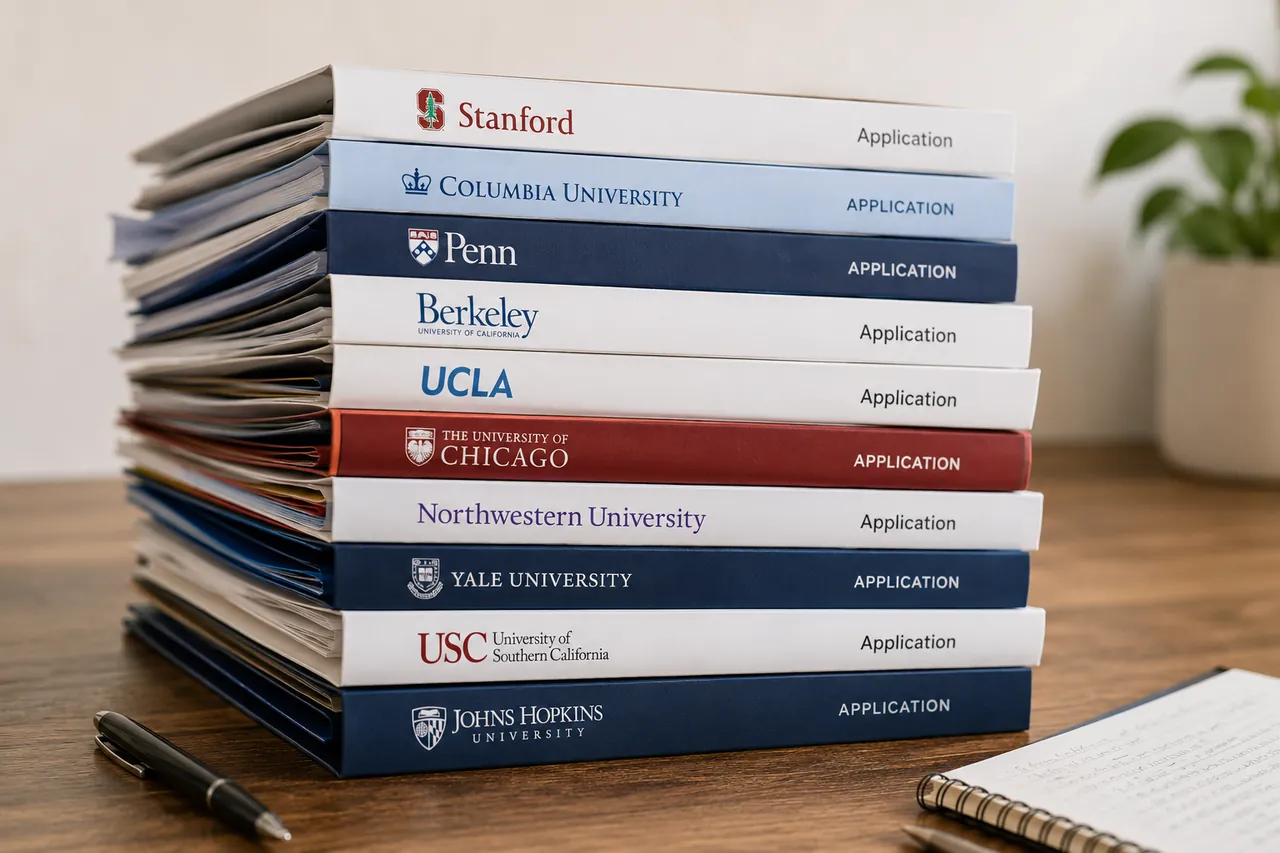
Every guidance counselor, college blog, and "Top 10 Tips" article tells you the same thing:
"Find a unique topic." "Show your growth." "Be authentic." "Tell a story."
It all sounds good. It's also all useless.
Because here's what your high school counselor isn't telling you, and what most college blogs don't either:
An admissions reader spends exactly 8 minutes on your kid's entire application.
Eight. Of those 8 minutes, only 2 are spent on grades and test scores. The other 6 decide everything, and roughly 4 to 5 minutes total are spent reading every essay your kid writes.
In those minutes, the reader is asking three questions every student is graded against, but no one ever teaches you:
This isn't a "find the right topic" problem. It's a system you can't see problem.
It was designed for a different era.
The old advice ("be unique, write from the heart, show growth") was designed for a system that had time to actually read your kid's essay carefully.
That system is gone. But the advice never updated.

No public school counselor, no matter how dedicated, can give your kid personalized essay strategy when they're responsible for 400 other students. They've never sat in an admissions office at UC Berkeley. They give you the same advice they gave the last 50 families.

They charge by the year, so most families end up dropping $40K to $80K across high school. And the one-size-fits-all playbook actively misfires for the UC system, which has completely different rules than Common App schools.
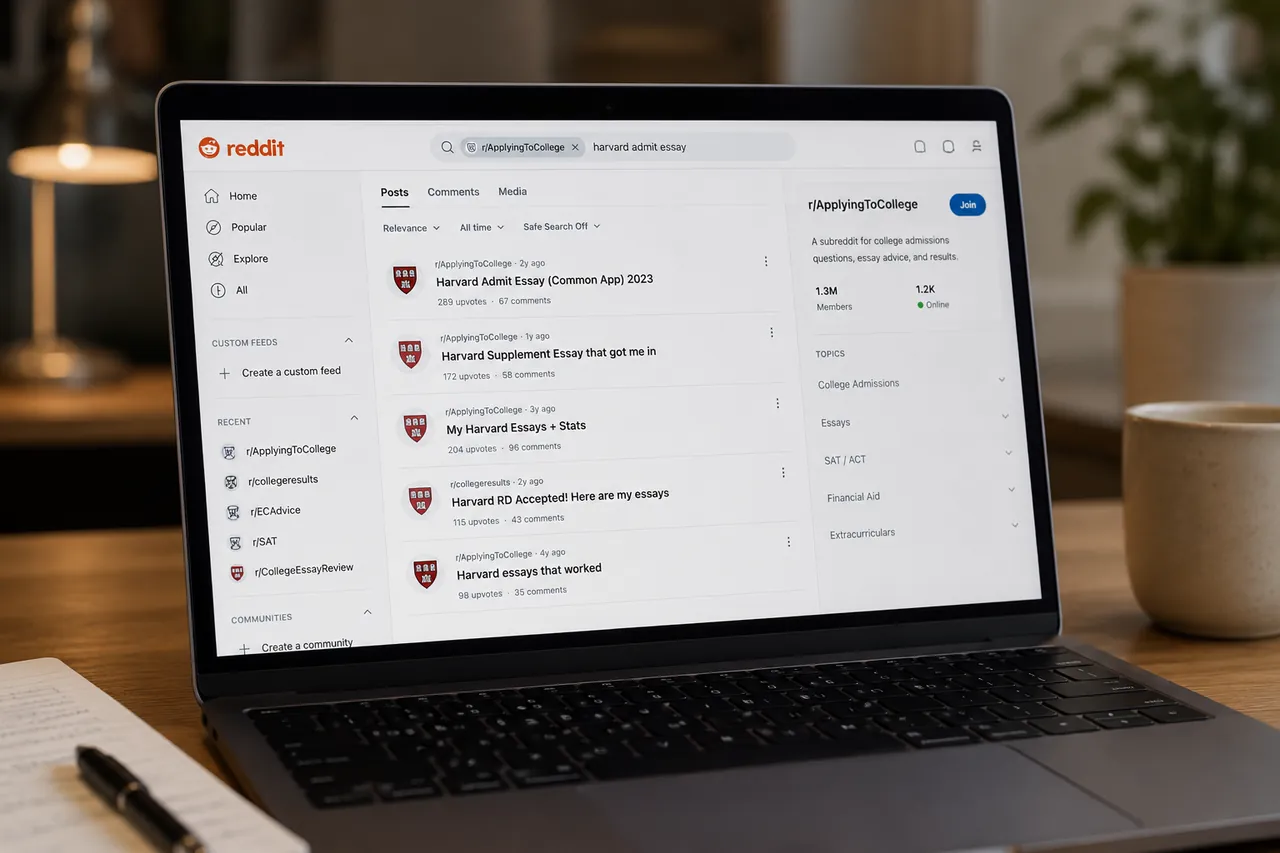
No context. You read a 'Harvard admit essay' but you don't know whether it's a Common App personal statement or a school-specific supplement, what the topic is in one line, or whether the kid had a recruited spike pushing them through. Without context, the essay teaches you nothing transferable.
We call it The Backwards Read. It's the same method egelloC uses with every Blueprint family, and it's how Coach Tony Le (former UC Berkeley external admissions reader, 10,000+ apps personally evaluated) trains parents to see essays the way an admissions officer would.
It works in 3 simple steps:
Instant access to all 27 essays from real coached students admitted to top universities. Every essay tagged with the school it got into, the essay type (Common App, UC PIQ, or supplemental), and the topic in one line. Both Common App personal statements AND UC PIQs covered.
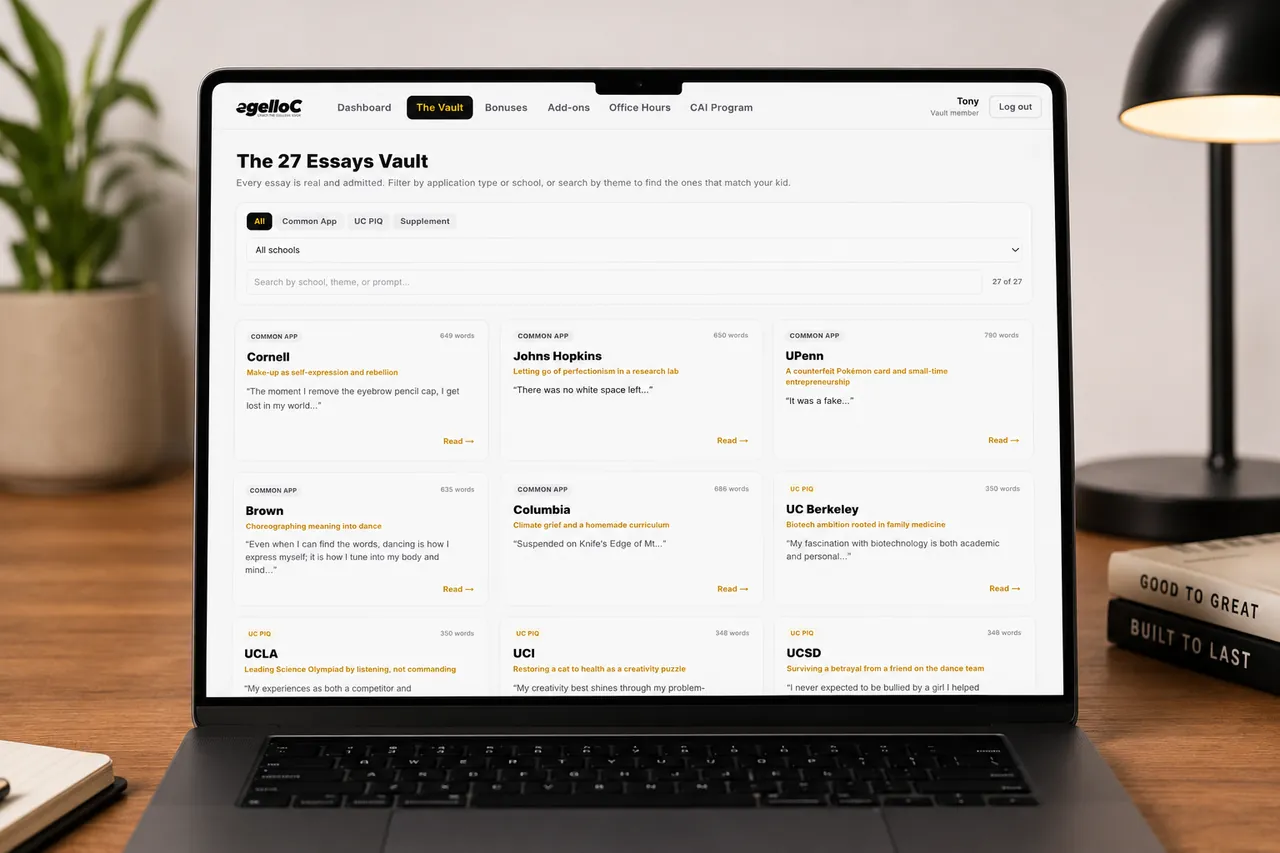
By the 5th or 6th essay, the same moves emerge. The same kinds of opening lines. The 70/30 reflection-to-story ratio (most parents think it should be 70% what happened and 30% reflection, but the vault shows you the winners do the exact opposite). The same way each essay reveals something only that one student could have written. The repetition does the teaching for you.

You can look at your own kid's draft, or even just their topic idea, and immediately tell whether it's on the right track. You stop feeling like an outsider trying to decode a system you weren't taught. You start feeling like someone who knows what good actually looks like.

You don't need to be a writer. You don't need to know anything about college admissions. Everything you need is inside the vault, and it fits right into the life you already have.
You don't have to be a writer or have ever read a college essay before. The vault does the teaching by showing you the pattern.
Read the first few essays and you're already spotting patterns. Not hours, not a weekend. A Saturday morning with coffee is all it takes.
Go through the vault before your kid writes, and you'll know what to encourage and what to redirect from the very first sentence.
Counselors, $20K consultants, and Reddit threads all run on the old model. This is a different model, which is why parents who'd given up finally feel clarity.
"Oh my gosh. I had no idea this is what they actually look like."
"I keep seeing the same thing in essay after essay. There's a pattern here."
"I just sat down with my kid and we looked at their essay together for 20 minutes. I knew exactly what to flag."
"My kid's draft is better in two weeks than I thought it would be in two months."
Each bonus removes a specific objection most families run into. All 6 are included with your $27 vault. No upsells, no catches.

Get 15 professional prompt breakdowns (every Common App prompt plus all 8 UC PIQs) that instantly make your kid's approach look like the work of a $20,000 private consultant's client. Skip 40+ hours of family debate over what 'describe a place where you feel content' actually means to an admissions reader, and start every essay with the exact prompt interpretations that admissions officers respond to.
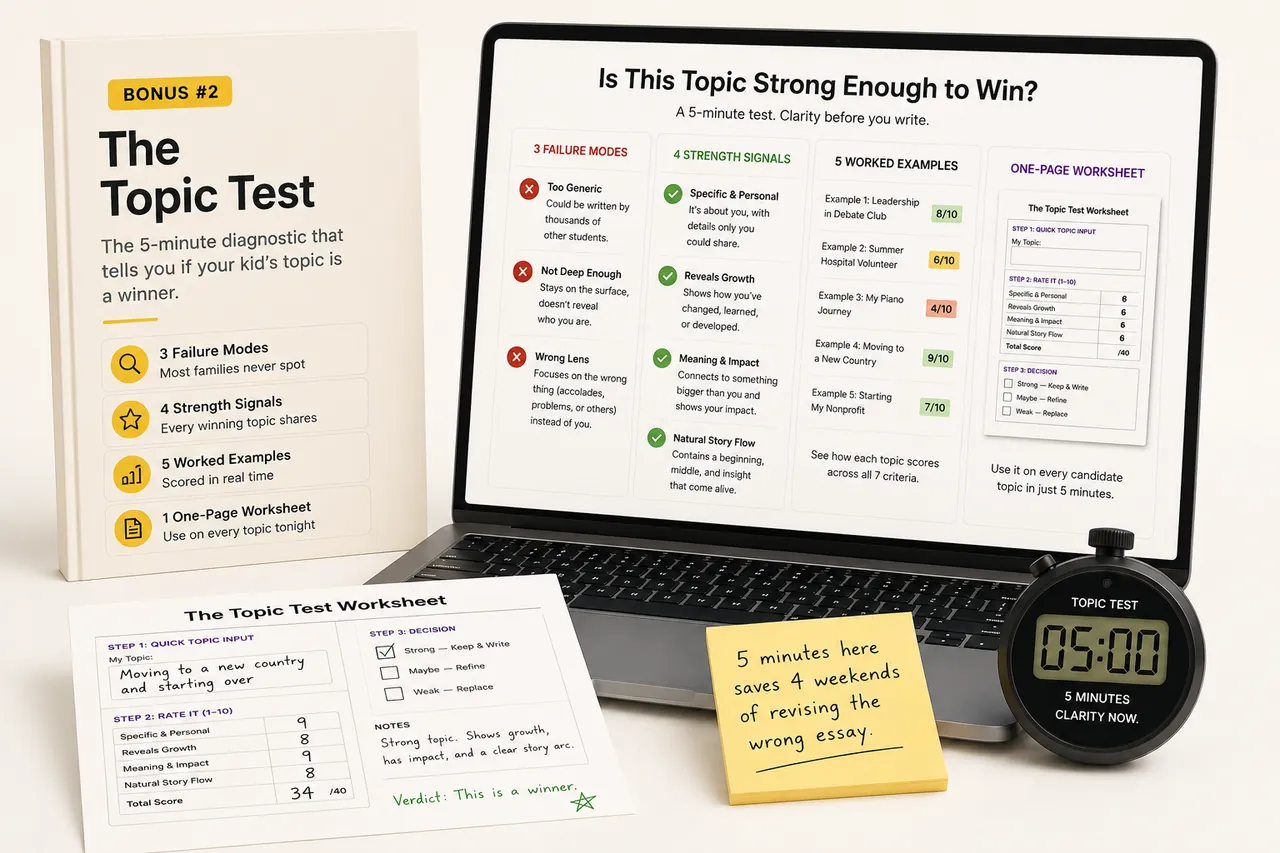
The 5-minute diagnostic that tells you — before your kid writes a single word — whether their essay topic is strong enough to win, or whether it needs to be replaced. Three failure modes most families never spot, four strength signals every winning topic shares, five worked examples scored in real time, and a one-page worksheet you can run on every candidate topic tonight. Five minutes here saves four weekends of revising the wrong essay.

The 5 categories of essay waste hiding in every first draft, demonstrated on a real UC PIQ cut from 612 words down to under 350 without losing what made it work. Stop trying to make your kid's essay shorter and start spotting what isn't earning its line on the page.

Exactly what to say (and what not to say) when your kid hands you a draft and asks what you think. The three sentences that quietly damage a draft, the three that always help, twelve common reactions translated from harmful to helpful, and a one-page script you can print and use every time. Built for parents who have never written a college essay themselves.
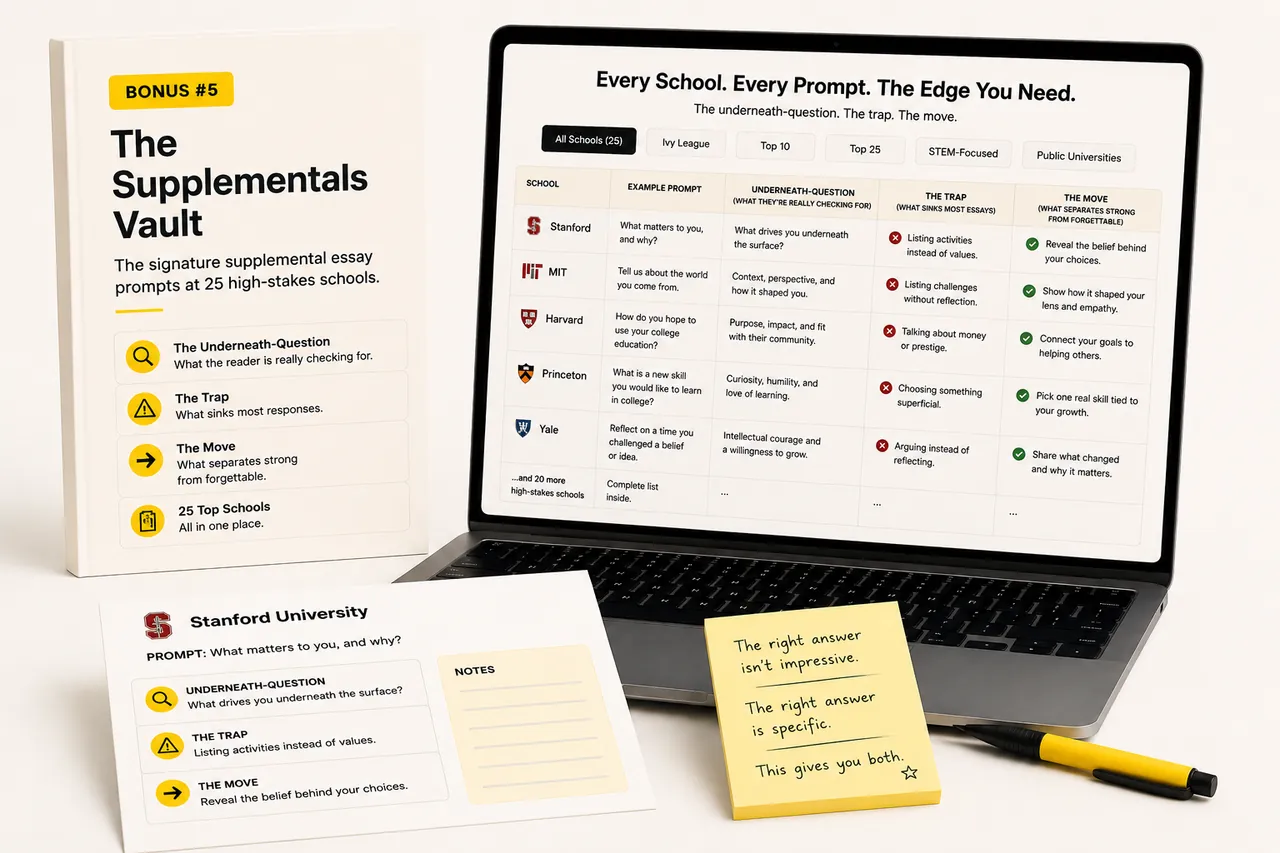
The signature supplemental essay prompts at 25 high-stakes schools (Stanford, MIT, Harvard, Princeton, Yale, Columbia, Penn, Brown, Cornell, Dartmouth, JHU, Northwestern, Duke, UChicago, CMU, Georgia Tech, UIUC, U-M, UT Austin, UW, Purdue, Vanderbilt, Rice, WashU, Notre Dame), each with the underneath-question the admissions reader is actually checking for, the trap that sinks most responses, and the one move that separates strong from forgettable.
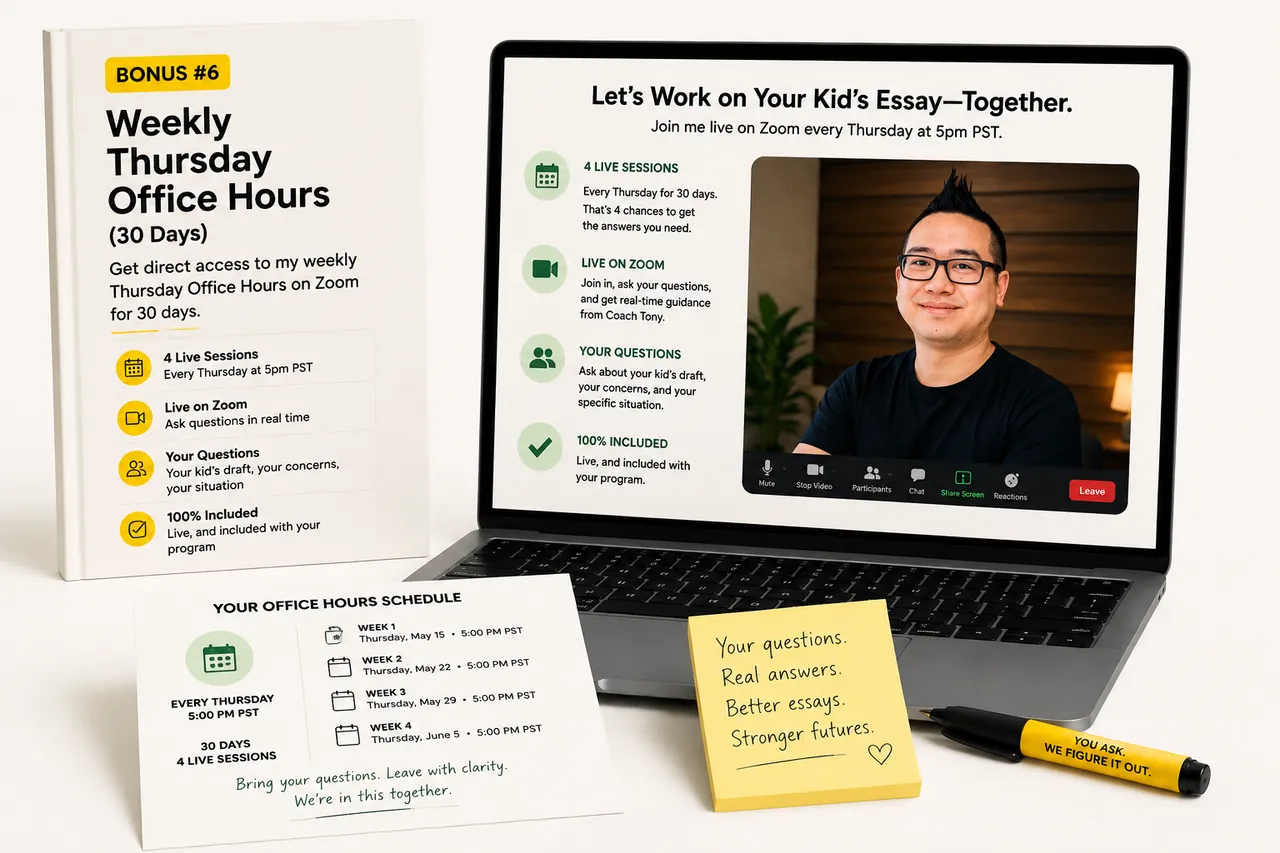
Get direct access to my weekly Thursday Office Hours on Zoom for 30 days. That's up to 4 live sessions with Coach Tony, every Thursday at 5pm PST, where you can ask about your kid's specific draft, your specific concerns, and your specific situation. Live only, no recordings — show up to get the value. 100% included.
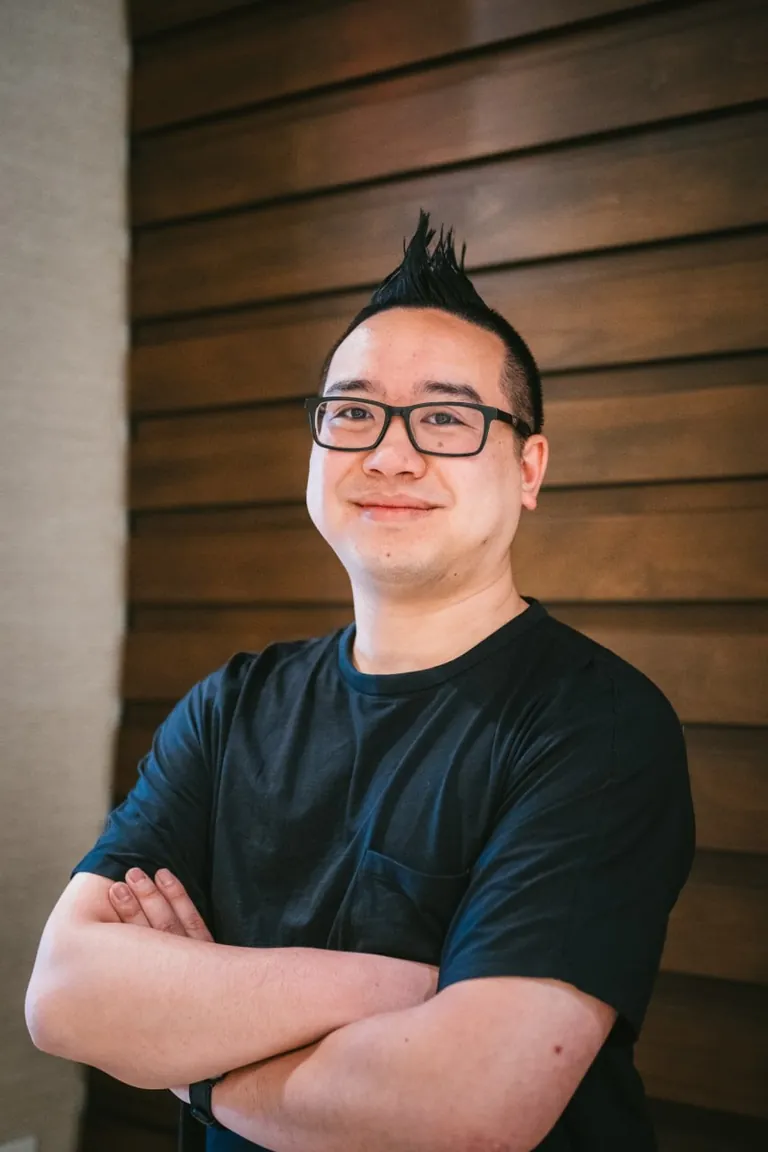
I'm Coach Tony Le.
Not a private consultant charging $80,000 per family. Not a Harvard alum who thinks Harvard is the only school worth getting into.
I'm a former UC Berkeley external admissions reader who's personally evaluated over 10,000 applications, and who's spent the last 16 years in college admissions watching the same heartbreaking pattern repeat itself.
When I started reading applications at Berkeley, I expected the rejected students to look obviously weak. They didn't. They looked just like the admitted students. Same GPAs, same scores, same activities.
The difference was always in the essays. Always. The rejected essays could have been written by anyone. The admitted essays revealed a specific, unmistakable person.
That's why egelloC was born. College spelled backwards, because everything we do starts at the destination (what an admissions reader needs to see) and works backwards from there.
Two students. Two different profiles. Same essay method.
Junior year. Parents both engineers. STEM-leaning. Wanted Cornell, but every family friend and counselor said she was reaching. The family was on the verge of pulling Cornell off the list entirely.
Got into Cornell with $69,000 per year in merit aid. Coach Tony's Backwards Read did it. Specifically, the 70/30 reflection ratio and the 'could only Priya have written this' specificity he coached her toward.
"It wasn't even her top-choice essay. It was the one she almost cut."
Multi-passion. Robotics, music, debate, no clear focus. Every counselor told his family he needed to 'narrow it down' before senior year, or he'd look unfocused to admissions readers.
Didn't narrow anything. Coach Tony walked the family through The Backwards Read, and the essays revealed the kind of student Ethan actually was - someone who connects ideas across fields. Got into UC Berkeley.
"The 'narrow it down' advice would have buried what made him interesting."
(Names used with permission. Full essays are in the vault.)
Get instant access to all 27 essays plus all 6 bonuses. Open your vault the moment you check out.

"I had no idea the reflection-to-story ratio should be flipped. After we saw the pattern in the vault, my daughter's essay completely changed."
"My son writes the same dry STEM essays everyone writes. Reading the vault taught him to write about non-STEM things in compelling ways. That got him in."
"Coach Tony's framing of the 8-minute reader stuck with me. Once I understood admissions readers had four minutes per essay, everything we wrote changed."
"First-gen immigrant family here. We were navigating this completely blind. The vault gave us the equivalent of a tutor we couldn't afford."
"My son does robotics, music, AND debate. Every counselor said he needed to 'pick a lane.' The vault showed us that's terrible advice for multi-passion kids."
"Read the whole vault in one Saturday morning. Came out understanding what UCs look for in PIQs better than after a year of YouTube videos."
"The 'could anyone else have written this' test broke through to my daughter in a way no teacher's feedback ever did. Genius framing."
"I'd recommend this to every parent. Twenty-seven dollars saved us thousands and probably a lot of family arguments."
"What I appreciated most was the tagging. Knowing the school, the essay type, and the topic up front made each one teach something specific."
"We were the family obsessing over 'unique topics.' The vault showed us topic isn't what wins, voice is. That insight alone was worth it."
"Both my kids will use this. Once you read 27 essays that worked, you read everything else with new eyes, including the next kid's drafts."
"Honestly the office hours alone is worth $27. Coach Tony's voice is in my head every time I read a draft now."
Look, I know that before getting into anything, I'd want to know what I'm buying and that it's backed by a real guarantee. And even though this is only $27, you worked for that money. It counts.
Like my grandpa used to say: "Test drive the car before you drive it off the lot."
Get the 27 Essays Vault, read through them, and if you don't feel like you suddenly understand what a winning college essay actually looks like within 30 days, just email tony@egelloc.com and we'll refund your $27.
And you keep the vault either way. Free of charge.
Need help? tony@egelloc.com